
Supply Chain Trends 2026
Global supply chains have moved past uncertainty, but challenges include economic volatility, evolving consumer priorities, constantly shifting trade policies, cost and sourcing pressures, and more. These challenges demand a fundamental operational overhaul, with leaders expected to do more, with less, while becoming tech disruptors, smarter, and more resilient – all at the same time. The path forward is anything but smooth and will require strategies that account for rising AI adoption, ongoing trade complexity, and evolving supplier dynamics.
Leaders face a defining challenge: how can we design supply chains to remain competitive, sustainable, value-driven, high-performing, and resilient? Drawing on our expert research, this blog provides a practical, action-oriented roadmap for supply chain leaders to navigate this shift.
AI will Scale Beyond Human Capacity
Many leaders believed artificial intelligence lived in presentations shown through datasets, benchmarks, and algorithms. It felt distant – promising, but abstract. That era is over. AI has embedded itself underground into systems you assume are just “working”, shaping outcomes without fanfare. Much like the internet, you don’t think about it when you turn on a switch or track a shipment. You simply expect it to work.
AI now works the same way across procurement, manufacturing, logistics, distribution, and everything else. The question is no longer whether organizations should adopt AI. The real question is whether your organization is just building flashy AI prototypes – or actively leveraging it to generate measurable business value.
AI insinuated throughout the supply chain functions, it can enhance demand planning by detecting subtle patterns humans miss, improve shipment visibility by forecasting delays before they escalate, optimize inventory by balancing working capital and service levels, manage risk by identifying vulnerabilities across global supplier networks, and adhere to compliance by reducing documentation errors and regulatory exposure.
In supply chain management, where disruptions are constant, margins are tight, and uncertainty remains a reality check, AI is no longer the future; it’s the utility running modern supply chains. In 2026, organizations that hesitate to embed AI will not stand still; they will widen the performance gap. Organizations that adapt AI quickly are likely to emerge as winners – not because they eliminate risk, but because they accelerate disruption response.
Visibility is More Than Just a Catchphrase – it’s a CFO Imperative
Traditional supply chains rely on data, built on silos of information. Modern supply chains thrive on visionary leadership, streamlined processes, and agile culture. Yet both worlds collide at a critical vulnerability: fragmented data across multiple platforms. A sub-tier collapse or regulatory breach can disrupt supply chain performance. Transparency is important for:
Early risk detection: Identifying vulnerabilities before impact operations.
Operational efficiency: Optimizing procurement, warehousing, and logistics & transportation.
Compliance: Enforcing ethical, social, and environmental standards.
Customer satisfaction: Improving lead times and service delivery.
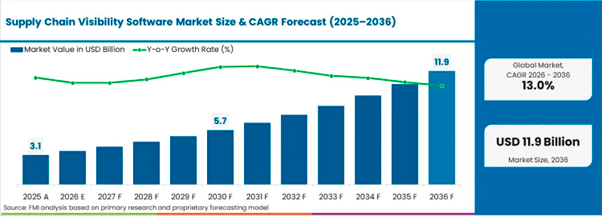
The era of blind spots in supply chain operations is over. Leaders must prioritise digital transformation strategies that integrate visibility platforms across procurement, warehouse, and logistics functions. Resilient growth will belong to leaders who understand and act faster. Three parallel forces are accelerating the adoption of supply chain visibility software. First, shipper expectations for real-time, multi-modal tracking and process automation. Second, the convergence of visibility and planning to integrated platforms for achieving real-time synchronization and faster decision-making. Third, a multi-enterprise data sharing model maturity for improved data governance and seamless collaboration. Discover how Quloi can help you enhance supply chain visibility.
Faster Delivery isn’t Just Preferable, it’s Paramount
Same-day delivery has struck a chord with today’s consumers. But logistics leaders could still compete by playing to their strengths. Longer lead times are no longer a tolerable inefficiency – they pose multifaceted challenges that affect inventory, financial performance, loyalty, and competitiveness.
Consumers have zero appetite for delivery delays, driving companies to achieve a high OTIF (On Time In Full) score. 80% consumers treat speed as a utility and competitive norm, expecting same-day delivery options. While 41% consumers are willing to spend more for same-day delivery; 28% have abandoned online shopping because the estimated delivery time exceeded their deadline.
The message is clear: delivery speed influences consumer trust, conversion, and retention simultaneously. This means leaders must design supply chains with cost-efficiency while also prioritizing responsiveness, last-mile agility, and promise reliability. That’s what the supply chain needs now – to invest in end-to-end visibility, hyperlocal fulfilment, faster last-mile execution, and predictive forecasting models. Supply chains will be better positioned this way to meet evolving consumer needs, cut lead times, reduce cart abandonment, and protect consumer trust.
Supply Chain Sustainability is a Non-Negotiable Deal
Sustainability in supply chains is no longer a branding exercise focused on compliance and annual disclosures. Extreme weather conditions, limited resources, and ESG obligations demand prompt action. A 2025 survey of over 500 finance leaders found that 93% of finance chiefs saw a clear business case for sustainability. 92% leaders expected to increase spending, and 65% measured the cost of failing to transition. With 2026 marking a decisive shift in supply chain risk management and ESG compliance, the challenge is no longer about sustainability commitment. It is whether a company can control risk, prove traceability, and protect margins at scale.
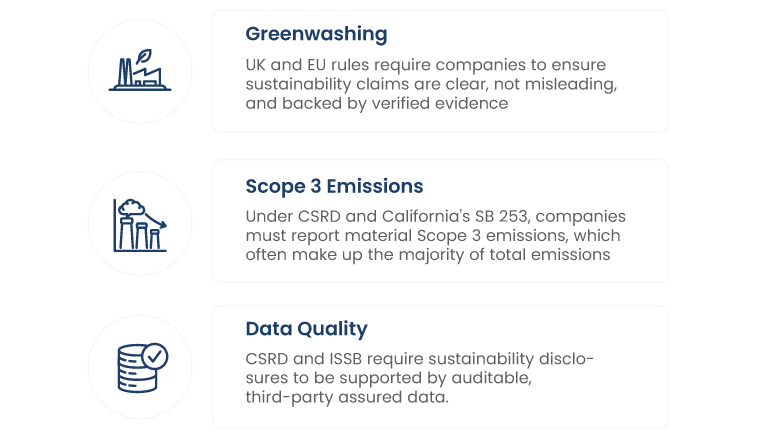
Supply chains that will define the next decade are not those that meet regulatory requirements or pursue net-zero at any cost. They are the ones that deliver solutions cheaper, faster, and better than the alternatives.
Regionalization – A Passing Trend or a Permanent Strategy?
Businesses that once treated globalization as the baseline of supply chain efficiency are now rethinking their sourcing strategies. The impact of regionalization is specific to every industry and sector. However, some industries are adversely affected by trade tensions and have a strong case for regionalizing part of their supply chain footprint. Companies that have fared the best are not necessarily the ones with the largest supplier bases. They are the ones invested in local partnerships to mitigate geopolitical risks.
A Forbes study claimed that 90% of industry leaders are shifting towards a closer-to-customer approach/regionalization, and dual sourcing strategies. This does not mean companies are abandoning global trade. It means they are geographically distributing suppliers in the markets they serve to enable agility and flexibility.
EY’s 2026 supply chain update highlights sourcing shifts toward India, Thailand, Vietnam, and Mexico as companies address tariff volatility and uncertainty through “China + 1” diversification. Regionalization is no longer a temporary trend – it has become a structural shift in global trade, improving responsiveness to local demand and supporting resilience.
It is Time to Act Now!
The most successful supply chains will not simply be efficient, but where resilience, productivity, sustainability, consumer trust, and margin protection converge. Supply chain leadership is becoming larger than operations – it is becoming a test for who can see sooner, measure accurately, adapt quicker, and perform better and consistently.
Are you willing to rethink, redesign, and recommit before the next disruption forces the decision on you?
Book a FREE Demo to learn how Quloi, a digital supply chain visibility and collaboration platform, helps you build resilient and future-ready supply chains.